

Humans May Return to the Moon This Week. Are Americans Even Aware It’s Happening?
It's hard to believe that returning to the moon for the first time in 54 years doesn't register as one of the biggest news stories in the world.
Photo via Unsplash, NASA Splinter NASA
Update: In an apropos demonstration of why it’s difficult to get excited for space missions until they actually happen, NASA has repeatedly delayed the launch of Artemis II after the threat of potential hydrogen leaks was detected during the February wet dress rehearsal. It now seeks to launch the week of April 1, 2026.
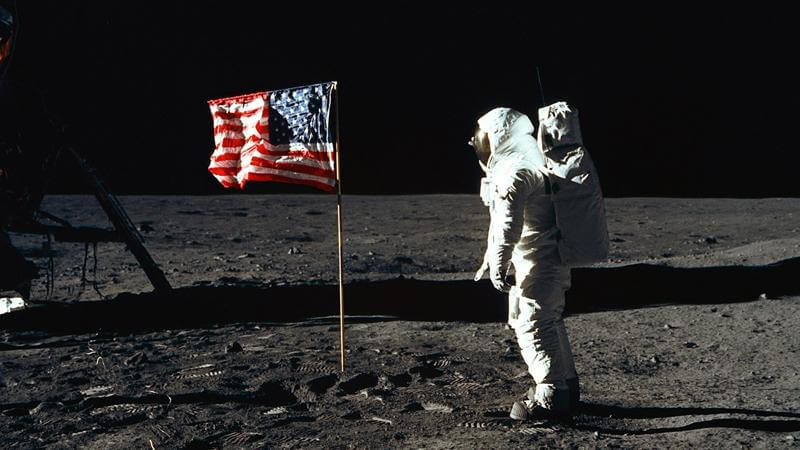
If you were compiling a shortlist of the most impressive accomplishments that human beings have achieved in our hegemony of the planet Earth, then surely somewhere near the top would be the fact that we somehow managed to land people on the moon on six different occasions between 1969-1972. It’s an achievement taken for granted in the popular consciousness—if not doubted and derided by the conspiratorial—because it happened so long ago, but suffice to say, going to the moon was not a stroll around the block. The sheer distances are difficult for the layman to fully grasp: Despite it being the closest celestial body to the Earth, our moon is roughly 238,900 miles from us, more than 30 Earth diameters. If you were somehow driving a car toward it on a space highway at 70 mph, it would take more than 142 continuous days of driving, without stopping, to reach it. That we ever got there was a miracle. And now, this very week, human beings are preparing to potentially launch from the Earth once again, bound for the moon for the first time in 54 years. So why does it feel like Americans are only distantly aware that the mission even exists?
Well, because we’re completely suffused in horror on a daily basis, for one. There can be little doubt that our current state of affairs in the U.S. is at least partly to blame for why the upcoming Artemis II moon mission—which aims to send a crew of four circling the moon on an observational run, and could launch as soon as Sunday—has seemingly not exactly captured the public imagination. We’re all waking up on a daily basis to find that ICE is shooting and killing Americans, or that it’s suddenly stopped reporting the deaths of its detainees. We’re getting massive dumps of Epstein Files, slinging pedophilia accusations at President Donald Trump and various captains of industry. We’re invading Venezuela and establishing a puppet government to extract oil, or threatening to roll tanks ashore in Greenland. We’re watching as tech companies double down on pornographic deepfakes of Americans, or as the number of measles cases skyrockets as we surrender to a disease we’d already beaten. Who has time to think about THE MOON?
And yet, the mission is indeed still happening, and it really should be a significant event in our country’s recent history. No human being has launched in the direction of the moon since the Apollo 17 mission in December of 1972, during the Nixon administration. And even though these astronauts are not intended to land on the lunar surface, the mission will be full of historic firsts and milestones. The 10-day mission will carry its crew—NASA astronauts Reid Wiseman, Victor Glover, and Christina Koch, along with Canadian Space Agency astronaut Jeremy Hansen, physically further than any human has ever traveled away form the planet. Glover will be the first black man to travel to the moon, Koch will be the first woman, and Hansen will be the first non-American on a lunar mission. They’ll set all kinds of aeronautic records in the process, including reentering the Earth’s atmosphere faster than anyone has ever done before.
During Artemis I Flight Day 13, Orion reached its max distance (>430,000 km from Earth). From this extreme range, our home world and its Moon appeared nearly the same apparent size to the spacecraft. Artemis II will launch with crew.
Credit: NASA/ APOD
— Astronomy 🔭 (@astronomy.bsky.social) Jan 31, 2026 at 1:15 PM
Crucially, it will be the first time that NASA’s Space Launch System (SLS) rocket program will carry humans to space, after as much as $23.8 billion has been spent on it since the early 2010s. Ditto the Orion deep space capsule, which has likewise cost many billions. The cost of the program, spread across the Trump and Biden administrations, has been utterly enormous, and each future SLS launch is still projected to cost more than $2 billion. This shit, in other words, needs to work.
To that end, the Artemis II mission/Space Launch System is today undergoing what is referred to as its “wet dress rehearsal,” in which every single step of a launch is physically simulated, up to the point of what would be moments before ignition. Its success can’t be assumed; during the build-up to the uncrewed Artemis I flight around the moon in 2022, the launch was delayed for six months after hydrogen leaks were found during the first wet dress rehearsal. If the test occurring throughout Monday is successful, though, the Artemis II mission could launch for the moon as soon as Sunday.
That said, those who have been paying attention to the story of man’s return to the moon know how riddled with setbacks and controversy this process has already been. In particular, the 2022 reentry of the Orion capsule revealed unexpected damage in the form of cracking/splintering to the capsule’s heat shield, which has been the subject of much engineering debate and planning in the few years since. NASA scientists are now confident that they’ve prepared as well as they possibly could prepare for the prospect of sending vulnerable human bodies around the moon once again in newly developed technology … but it would be hard to blame anyone for not wanting to be the first person to test reentry in said capsule. As is always the case, these astronauts are bravely taking their lives in their hands.
There is also, of course, a prominent political element that is ever-present in how missions like Artemis II are conceived, framed and presented to the American and global public. The Artemis program began in earnest during the first Trump administration, and it’s not difficult to imagine how the prospect of returning to the moon, and the grand vision of American exceptionalism it projects, would appeal to a man like Trump who values the symbolic grandeur of achievements more than the scientific value of them. Will there be a certain reticence from liberal Americans to take any sense of pride or accomplishment in moon landings if their primary function for the administration is to puff up Trump’s ego? Is it possible for any topic to be extricated from partisan bickering?
Nightfall In Miracle City
— Derek Newsome (@derek.space) Feb 1, 2026 at 8:23 PM
Regardless of the potential answers to that question, you don’t have to look far in order to find NASA and space geeks online openly wondering why the mission hasn’t gotten more prominently placed media coverage, or bemoaning that members of the public don’t seem to be aware of the mission’s existence, much less full of excitements for its possibilities. One gets a sense that they fear a lack of public interest could lead a mercurial Trump administration to curtail the future of the program in the face of setbacks and mounting costs, ending the prospect of a space exploration revival before it ever truly has a chance to get going, or leaving it in the ketamine-soaked hands of the likes of Elon Musk. The next mission in the series, Artemis III, is already reportedly at risk of going from being a crewed moon landing, to another less-ambitious task.
It’s not that the news media hasn’t covered the project and the build-up to this launch, although rarely has Artemis II been a lead story. It’s that we’re so inundated with other horrors or momentary distractions that even something happening in a few days tends to be sorted into the “it can wait until later” file in terms of devoting attention toward it. One would think, or at least hope, that once the mission is about to launch, or once the astronauts are in the air, that public interest in the program will spike tremendously. Going back to the moon for the first time in 54 years deserves to at least crack the upper echelon of Google Trends, or something is very wrong with our society.
 Keep scrolling for more great stories.