

SpaceX Stock Looks Like a SpaceX Rocket Launch
SpaceX stock is now under its IPO price, and its bonds are trading at junk bond rates.
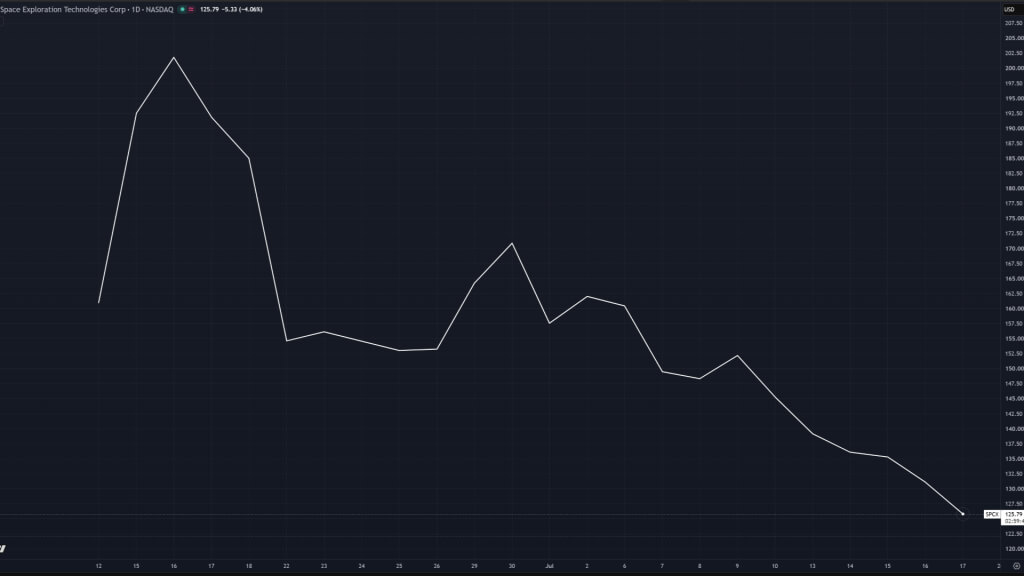
Photo of SpaceX stock chart by TradingView Splinter SpaceX
On December 9th, 2020, SN8, SpaceX’s prototype for its flagship Starship rocket, rose to its target elevation of 41,000 feet, then according to Elon Musk, “Fuel header tank pressure was low during landing burn, causing touchdown velocity to be high & [Rapid Unscheduled Disassembly],” which is his cutesy way of saying that sucker accelerated into the Earth, creating an explosion straight out of a Michael Bay movie. “AWESOME TEST. CONGRATS STARSHIP TEAM!” flashed an on-screen message during SpaceX’s live stream of the test launch that blew up, and Musk claimed that “we got all the data we needed! Congrats SpaceX team hell yeah!!” This wound up being one of the least subtle metaphors in human history, demonstrating how Elon Musk whips up investment for his companies, and then what he actually does with it.
Musk: “SpaceX will be worth more than the rest of Earth if we accomplish our goals”
— Matt Novak (@paleofuture.bsky.social) July 9, 2026 at 1:09 PM
On June 12th, 2026, SpaceX launched its Initial Public Offering (IPO) at $135 per share, and debuted on the public markets at $150 per share, making Musk the world’s first trillionaire and SpaceX larger than the company with the highest revenues in the world, Amazon. It rose as high as $225.64 per share a few days later, briefly making the company larger than Microsoft. A little over a month since it began trading, it has been down only from that top as the chart above demonstrates, and as I write this, it currently sits below its IPO price at $124.50 per share. Many investors are sobering up to what they actually bought now that the IPO hysteria has abated a bit, and it’s not a pretty picture.
In 2024, SpaceX made $791 million in net income. In 2025, it lost $4.9 billion. What changed? Elon Musk using SpaceX to bail out his xAI investors. That division posted $6.4 billion in operating losses versus $3.2 billion in revenue. You are not just buying SpaceX when you buy SpaceX stock; you are buying the MechaHitler site that’s “barely breaking even” per Musk’s own admission, plus its racist chatbot that produces CSAM on demand.
Plus, the other big form of business for SpaceX outside its rockets that explode every so often is seeing diminishing returns. The company’s first quarter revealed that Starlink’s average revenue per user declined from $86 to $66, reflecting its push to expand its satellite internet business into lower income countries who cannot afford U.S. subscription rates. Starlink increased its total subscribers to 10.3 million, but this dynamic reveals a common problem that a lot of businesses have failed to overcome in the past: their pace of new subscriber acquisition must outrun its declining per-subscriber economics if it is to keep increasing total revenue. This could be a very manageable situation under a normal company being valued by normal processes on normal things like profits (of which SpaceX has none), but this is not a normal company. It’s one that is, or was, being valued at over 90 times its revenue, placing pressure on the company to resolve this fundamental tension at the heart of their Starlink business model while keeping their later equity investors’ heads above water that is presently about $750 billion higher than Wal-Mart’s market capitalization.
If it was just a post-IPO price decline, many Musk apologists could just point to the history of splashy IPOs and how things don’t work out so great in the near-term for people who buy shortly after listing, but one look at companies like Google demonstrates how long-term investors still made out like bandits on IPO day. One teensy little problem with that analogy is that after Google IPO’d, it didn’t issue a bunch of bonds that quickly started trading at junk bond levels.
Beyond revenue, companies support their operations in two ways: debt and equity. Equity is another word for stocks, and debt is another word for bonds. If you are an early stockholder, assuming the company can absorb additional debt, you would prefer it issue bonds to fund its operations rather than issue new equity (ideally you’d invest in a company who makes money and can fund its own operations, but alas), because new equity dilutes your existing slice of the company and makes it worth less on paper. Plus there’s all sorts of financial chicanery our regulatory environment has created around debt maintenance and how you can use it to make your company look more profitable than it is, so issuing debt itself it not a cause for concern or a nefarious action. Companies do it to fund long-term investments all the time, and SpaceX did it shortly after they launched their stock on public exchanges. The problem is that interest rates reflect the market’s belief in how risky loaning you money is, and, well…
“Looking only at the nine days since the bonds were included in ICE BofA indices at the end of June, this spread-widening has made SpaceX 2056 the single worst-performing US dollar triple-B benchmark bond,” wrote the Financial Times this week. These $25 billion bonds set to be repaid in 2056 have seen their spread over the rate U.S. Treasuries pay (known as the risk-free rate) rise from 1.75% to a whopping 2.31%. This means that investors are selling bonds and demanding to be paid a higher interest rate to take the risk of loaning this company money for 30 years. If you had been allocated $100 million of these bonds on the first day of trading, FT notes that “you’ve turned $100mn into $90.7mn in less than a month.” They overlaid the average spread for double-B US dollar corporate bonds across different maturities and the chart it produced “looks a lot like the type of risk that the market has assigned to both SpaceX and Oracle bonds is junk risk.”
This presents additional downside risk to SpaceX’s stock price, because if the debt markets are charging him junk bond rates to borrow money, and the opaque private credit markets that have grown in presence as a vehicle to fund companies are seeing banks de-risk from them, well, that just leaves additional equity issuance to fund an unprofitable business. SpaceX listed this as a future possibility when they filed for an IPO, and doing it wouldn’t be anything out of the ordinary, except again, it is currently the seventh largest company on the planet and would have to accept driving its share price down further through the simple laws of supply and demand.
Additionally, equity buyers must assess future governance risk around investing in a company like this for the long-term. SpaceX’s filings are opaque and follow the Tesla model where sources of revenue are not exactly crystal clear, and the company lists one client as being responsible for 21% of SpaceX revenue. That client is almost certainly the United States federal government, presently run by Elon’s Epstein Island buddy, Donald Trump. What happens to SpaceX’s business if Jon Ossoff and his anti-corruption campaign took office in 2029? Or Alexandria Ocasio-Cortez? How many Democrats would you trust to keep this private monopoly on the U.S. space program in place?
So the natural question for all us Elon haters is how bad can it get. There are plenty of unhinged upside valuations that ignore the gargantuan cost of cooling data centers in space and other revenue models that logic dictates SpaceX will struggle to clear, as well as plenty of doomers saying it will follow SM8 all the way to its firery grave at $0 a share, but Starlink has proven to be a very credible business and while Musk has achieved dominance via regulatory capture, being one of the few companies in the world who can build reusable rockets that usually return safely to earth is a valuable business. The entire problem with this whole ordeal is the unhinged valuation fueled by the dark accounting arts Musk perpetrated with xAI, and the struggle of trying to project out some kind of future financial coherence from this present shitshow.
Morningstar, one of the financial world’s premier research outlets, values SpaceX at $63 per share, another 50% drop from its present share price that is a nearly 50% fall from its all-time high. It uses radical things like, uh, Discounted Cash Flow analyses I was forced to learn how to do before they unlocked any of the other doors in my finance school, and they find that “the discounted cash flow assumptions embedded in SpaceX’s share price are exceptionally demanding.” They even compared it to past IPOs and found that “valuation stands significantly above the multiples commanded by major technology listings, despite a growth outlook that is not necessarily superior.”
SpaceX debuted at 94 times its revenue multiple, compared to the previous high in their sample of 22 for then Facebook, now Meta. Tesla’s IPO came at 17 times its revenue multiple. SpaceX stock is an entirely different ballgame, and the scale of what the market is currently being asked to prop up is unprecedented. Right now, about $10 under its IPO price, this unprofitable company is larger than Visa, ExxonMobil and Coca-Cola—combined. Part of its present valuation is based on a smaller supply of shares being available on the public market, and that dynamic will fundamentally shift as the lockup period for early SpaceX and bailed-out xAI investors ends in stages over the coming months and quarters and years, bringing a tidal wave of equity supply and sell pressure to mankind’s most over-valued company currently borrowing money at junk bond rates. What could possibly go wrong?
 Keep scrolling for more great stories.