

25 U.S. States Want to Ban Minors from Social Media. Will Any Succeed?
Many of the state bans are tied up in litigation, and each tackles issues of social media addiction and social development in different ways.
Photos via Unsplash, Berke Citak, Bruce Mars Splinter social media
At what age should a minor, with or without parental consent, have a legal right to make themselves one with the brain rot of Facebook, Instagram, TikTok, Twitter/X and others? That is the seemingly simple, but ultimately loaded question at the heart of dozens of pieces of state legislation (and even more advancing lawsuits) that seek to curtail the access of teenage Americans to major social media networks. Citing various studies on the potential adverse effects of social media exposure for kids and young adults on both social, mental, and neurophysical development, half of U.S. states have now either enacted or introduced legislation involving age-related social media regulation. Although a few have advanced all the way to enforcement, most of these bans and quasi-bans are still either stuck in bitter debate within state legislatures, or their enforcement is paused, tied up in nigh-inevitable legal challenges on First Amendment grounds. The stage feels set for one of these state cases to eventually advance all the way to the U.S. Supreme Court–which has for now washed its hands of deciding the issue–where the legality of these types of state bans could finally be decided. However, because each state has approached the above question through unique means–sometimes subtly and other times wildly differently–we are left with a topic of ever-expanding complexity, involving the operations of some of the world’s biggest and most powerful corporations.
It’s complicated shit, in other words. States attempting to move ahead with or enforce their youth social media bans find themselves up against industry groups such as NetChoice or the Computer & Communications Industry Association, whose membership includes the likes of Google, Meta and Snap Inc., all of which have obvious financial incentives to avoid more regulation of their lucrative younger user base whenever possible. This has left the topic in legal limbo in numerous U.S. states, even as more legislation continues to be introduced in states that don’t yet have minor social media bans on the books. Any state bans that do get through will join a growing chorus of international/global age-based social media bans, including under-16 bans in Malaysia and Australia, the latter of which goes into effect on Dec. 10, 2025. Said Australian ban would punish social media companies for “serious or repeated breaches” in enforcement, and requires those companies to take “reasonable steps” to keep minors off the platforms through the use of age-verifying technology.
From a purely child development front, it’s hard to not be at least somewhat sympathetic to efforts to keep social media from fully and hazardously dominating the lives of young people. There’s no dearth of studies that have demonstrated how fraught this experience has been for members of Gen Z and Alpha who have grown up in the cradle of social media, exposed to its algorithms from the time they could first read or write. The brains of kids reared on social media quite literally develop differently than prior brains ever have, and there’s little reason to believe that’s a good thing. Kids who spent a lot of time on screens often struggle to meet developmental milestones as fast as kids who have less screen exposure.
“Increased screen time can reduce the integrity of brain structures that support early literacy in pre-kindergarten students,” said Dr. Heidi Allison Bender, a neuropsychologist with NewYork-Presbyterian/Weill Cornell Medical Center. “You can see delays in language acquisition and problems with sustained attention and multitasking.”
And kids, by and large, do have vast amounts of access to screen time these days. According to the U.S. Surgeon General’s 2023 Social Media and Youth Mental Health Advisory, nearly every U.S. teen (96%) between the ages of 13-17 uses the internet daily, and almost half self-report that they are online “almost constantly,” according to a 2024 Pew Research survey. And despite the fact that most of the biggest social media platforms require their users to be at least 13 years of age to sign up, an estimated 64% of children age 8-12 still use YouTube and TikTok every single day.
We are talking about vast swathes of time and engagement here: Teens between 13-19 spend an average of 4.8 hours on social media networks every day according to Gallup, which rises all the way to 5.8 hours per day in 17-year-olds. Even Gen Alpha kids between 8-10 reportedly spent up to 4 hours per day on social media. This, despite the aforementioned Surgeon General’s advisory, which states that adolescents who are using social media for more than 3 hours per day are at “twice the risk of experiencing poor mental health outcomes.”

One of the flip sides of the argument, on the other hand, is that youth social media bans rely upon technology such as invasive age-verification and data collection to enforce, thus infringing on the freedoms of users. In Michigan, where a social media ban for teens 17 years and younger (without parental consent) is currently under discussion by the Michigan House of Representatives, libertarian think tank Reason Foundation has attempted to stake the issue as one that would result in costly lawsuits against the state, not just from tech companies but from users.
“Michigan has nothing to gain by throwing its hat in the ring other than bearing the costs of hefty attorney’s fees to defend the bill that has been abandoned even by advocates in Utah, the state that pioneered this bill,” said Reason Foundation managing director of technology policy, Caden Rosenbaum. “The bill before you today places a burden on people’s First Amendment right to speak by requiring them to identify themselves with privacy-invasive age verification requirements. That would mean showing an ID or forking over biometric information just to prove that they’re adults, to speak their mind, to disclose the truth or even just learn what others have to say.”
Where Do States Stand on Youth Social Media Bans?
The reason that most social media companies have (technically) set their minimum age of enrollment to 13 is because of the one piece of legislation on the books that governs this kind of thing: the Children’s Online Privacy Protection Act of 1998 (COPPA). As the year at the end of that piece of legislation might suggest, it predates the dawn of modern social media sites, and thus provides little direct regulation regarding them, beyond the fact that it makes platforms legally responsible for children under 13 creating accounts that collect data without parental approval. This has made social media corporations largely set 13 as the minimum age in order to avoid obligations related to COPPA, but only recently have most of these companies had to get the least bit serious about actually enforcing age limits when sign-ups mostly relied on self-reported age data, without hard verification.
The 25 U.S. states that have attempted to introduce some kind of legislation to this effect–you can see them in the map below, from government relations company MultiState–have approached the topic with varying levels of stringent expectation for social media companies, starting with the age of users that would be allowed to sign up for an account. In legislation introduced by states such as Kentucky, North Carolina and Maine, only minors under 14 years old would be barred from creating accounts. This age range goes all the way to the likes of Texas and Nebraska, which both drafted legislation that bars anyone under the age of 18 from social media services without parental consent. The aforementioned Nebraska ban appears to be the most strict one in the country that is not caught up in a legal challenge, and is slated to go into effect on July 1, 2026.
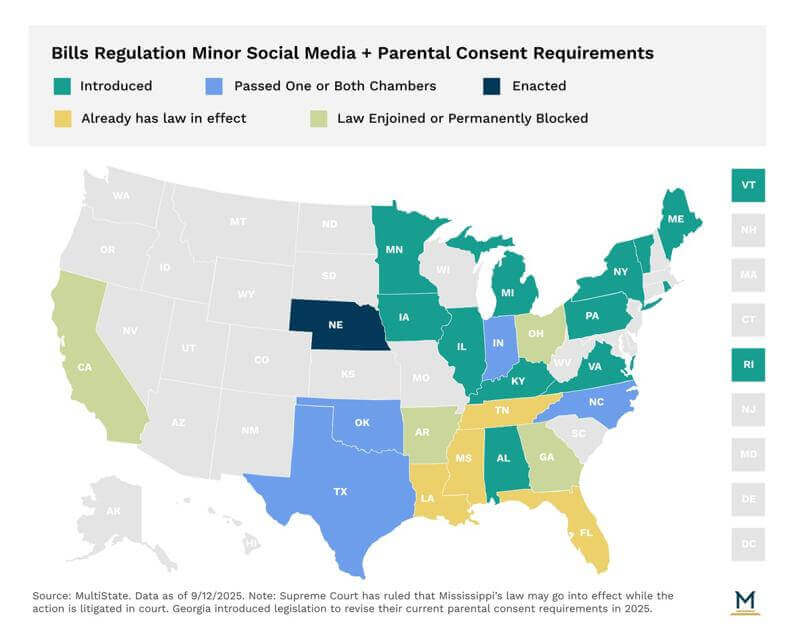
Chart by MultiState.
Still other states have approached this issue in radically different fashions, creating legislation not to ban users under a certain age, but to instead regulate some other part of either user consumption, or what is being consumed. Virginia, for instance, sidestepped an age-based ban by passing a piece of legislation (taking effect Jan. 1, 2026) that bars minors from accessing individual social media sites for more than one hour per day without parental consent. Which is a pretty wild idea, given the data we saw above about how much time youths tend to spend on social media in any given day! One might also wonder: How the heck are parents supposed to “give consent” for their kids to exceed the time limit?
Well, the legislation says the following: “Any controller or processor that operates a social media platform shall (i) use commercially reasonable methods, such as a neutral age screen mechanism, to determine whether a user is a minor and (ii) limit a minor’s use of such social media platform to one hour per day, per service or application, and allow a parent to give verifiable parental consent to increase or decrease the daily time limit.” As for “consent,” it says the following: “”Consent” means a clear affirmative act signifying a consumer’s freely given, specific, informed, and unambiguous agreement to process personal data relating to the consumer. Consent may include a written statement, including a statement written by electronic means, or any other unambiguous affirmative action.” So as to how that works on say, TikTok or Instagram, your guess is as good as mine. A screen pops up when you hit your time limit, you take your phone to your parent, and they have to sign to allow you to continue using it?
The population centers of California and New York, meanwhile, have instead passed legislation targeting something more elemental to the social media experience: The scroll/feed and the algorithms that power it. They have become the first two states in the U.S. to tackle the issue through regulation of “addictive algorithms” and features described as being specifically designed to increase interaction and addiction in minors. California’s law, which states that even parental consent doesn’t provide freedom from liability for harm to minors caused by the addicting power of social media, is currently being challenged in federal court, but has been permitted to go into effect while the lawsuit plays out. This essentially means that a separate, “non-addictive” algorithm would need to be used by social media companies for minor users. In New York, meanwhile, Attorney General Letitia James (whose Trump-demanded indictment recently fizzled) recently released proposed rules for the state’s own addictive algorithm ban under the Stop Addictive Feeds Exploitation (SAFE) for Kids Act. According to the Attorney General’s office, the act “requires social media companies to restrict algorithmically personalized feeds, or addictive feeds, and nighttime notifications for users under the age of 18 unless parental consent is granted. Addictive feeds and nighttime notifications are tied to depression, anxiety, eating and sleep disorders, and other mental health issues for children and teenagers.”
All told, eight states (Arkansas, California, Florida, Georgia, Louisiana, Mississippi, Ohio, Tennessee) have currently passed legislation that amounts to a youth social media ban on one level or another, but most are tied up in litigation. The Mississippi law in question is the closest that this topic has so far come to the United States Supreme Court: Tech industry group NetChoice petitioned the Supreme Court to temporarily bar the state of Mississippi from enforcing its ban, but the justices declined the request, allowing the ban to remain in place while it advances through the court system. The court did not explain its reasoning for doing so, but tellingly, Justice Brett Kavanagh did write a short concurring opinion that stated that the Mississippi law was likely unconstitutional. Does this signal that the court will ultimately come out against youth social media bans, down the line?
Regardless, more of these bans are slowly but steadily going into actual enforcement. Just this week, the U.S. Court of Appeals for the Eleventh Circuit in Florida ruled that the state can discard the preliminary injunction against its youth social media ban that was placed by a federal district judge in June, and begin active enforcement of the law. The legislation, passed in 2024, bars Florida residents younger than 14 from having accounts on social media platforms with “addictive features,” and also requires parental consent to create profiles for users 14-15 years old. Florida Attorney General James Uthmeier vowed to “aggressively enforce” the law, beginning immediately, while Governor Ron DeSantis crowed about “protections for kids against predatory social media companies.”
With billions of dollars on the line, this is an issue that is clearly coming to a head in the near future. Who among us has the right to brain rot?
 Keep scrolling for more great stories.