

We Have a New Metric to Measure Which Pitcher’s Stuff is Filthiest
We can now tell which individual pitch types, from which pitcher, get hitters to miss by the largest amount.
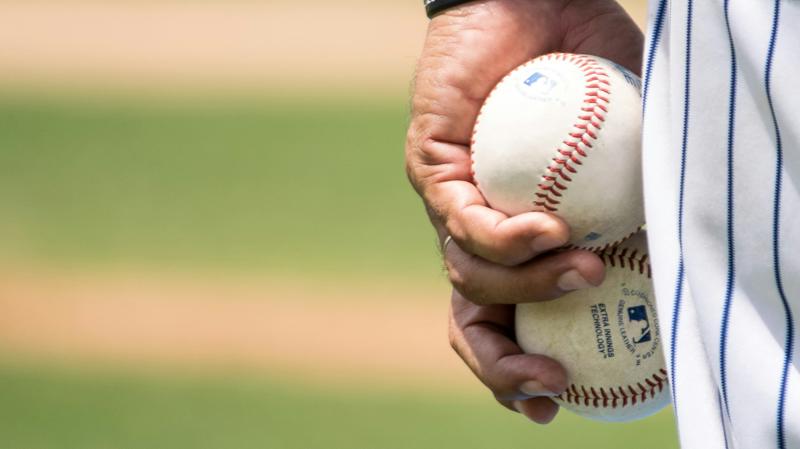
Photo via Unsplash, Jose Morales SplinterSports baseball
Never doubt for a moment that in addition to the obvious application of “figuring out how to help pro sports players perform better,” the true use case for most advanced baseball statistics in particular is the settling of sports fan arguments and grievances. Sports geeks can argue forever, of course, about topics like which pitcher is baseball’s most dominant, or possesses the most spectacularly devastating arsenal of pitches. But if you know how to measure and gather the data, you can also leverage the untold statistical analysis that is now freely available at our fingertips to calculate a more concrete answer to a question like “which pitch is filthiest”? As it turns out, it’s Mason Miller’s slider.
As is often the case with these types of things, the number we discover satisfyingly confirms what the eye test already pretty much told us: There’s no reliever/closer in baseball more unhittable than the Padres’ Mason Miller in 2026, and it makes perfect sense that his best pitch, the slider, would also be the hardest to hit individual pitch in the game. Per the new “Swing Timing + Miss Distance” tool in Baseball Savant/Statcast’s bag of tricks, though, we can finally measure precisely where any given pitcher’s devastating curveball, slider, sweeper or changeup ends up in comparison. Miller’s slider leads the way, with an average miss distance of 10.6 inches. Which is to say, when a hitter swings and misses at a Mason Miller slider–a very common occurrence–they’re usually missing the pitch by nearly a foot. The bat is essentially passing through in an entirely different time zone than the ball. What does this look like in practice? Well, sort of like what Miller does to incoming All-Star Nationals slugger James Wood right here. Talk about your ugly swings.
Of course, you still need to know how some of the terms are truly defined in order to fully appreciate the pitchers now generating MLB’s biggest whiffs. Importantly, in terms of the Statcast leaderboard, the “bat” is defined as the fattest, central part of the bat, or its barrel. Thus, a typical “miss” of a few inches could actually be a pitch that struck the bat itself, but hit it near the far tip or in on the hands where the bat is thin–i.e., “bad contact” that is unlikely to result in a hit. The average distance of all misses together is three inches. Mason Miller’s typical slider misses by far more at 10.6 inches, but the above embarrassing swing from James Wood apparently missed the pitch by a measured 25 inches from the barrel of the bat. But the misses get even more comically large–the all-time record for the Statcast era was set last year by the legendary Clayton Kershaw, who in a June game broke off a 55-foot curveball that bounced well before home plate … but still generated a swing anyway from Mets rookie Ronny Mauricio. As far as we know, this is the record holder for the biggest single miss any hitter/pitcher has generated in the Statcast era. Looking at the others, one will note that the biggest single misses are pretty much all in the dirt, because it’s the only way the barrel of the bat could be far enough away from the ball to make the leaderboard.
Looking at the overall leaderboard, another thing is obvious: You’re not going to see any four-seam fastballs on there. Although the fastball remains the foundational pitch in baseball, and although they still can generate plenty of swing and miss, especially at the top of an increasingly stingy strike zone, the flatter shape of fastballs mean they miss the bat by a smaller measured amount. The kings of miss distance are all naturally offspeed and breaking balls, with some of the other top finishers being pitches like Andrew Abbott’s curveball, or Blake Treinen’s famously bendy sweeper. These make up almost the entire top 50, with just a couple of rogue changeups and only one fastball variant rounding out the pack, in the form of the splitters used by pitchers such as Fernando Cruz and Trey Yesavage.
It’s worth noting, however, that there’s also a situational element at play here. Is Mason Miller’s slider the very best and most filthy in MLB purely on shape alone? Probably not–you could give that slider to an otherwise ineffective pitcher and it wouldn’t turn him into a star overnight. What makes it so devastating in Miller’s hands is not only the fact that he can command it well, but also the dominance of the rest of the closer’s arsenal, predominantly his 103 mph fastball. Most pitchers gifted with such an overbearing fastball would likely base their entire approach around it, but Miller has thrown it only 42% of the time in 2026, easily the lowest mark of his career to date. He has become a more complete pitcher in the process, using the threat of the overpowering fastball to keep hitters further than ever from making contact with his actual put-away pitch, the slider. And every time you finally tell yourself that a slider is coming? That’s when you get 100+ mph up and in.
The pure dominance of the Mason Miller slider, however, was particularly highlighted in this half inning from last season, in which the newly anointed (at the time) Padres closer managed to pitch an immaculate inning–three strikeouts on the minimum of nine pitches–using only the slider. An immaculate inning is already rare enough; there have only been 121 recorded instances of it since 1889, during which time an estimated 4.3 MILLION half innings have been played in MLB. To register an immaculate inning with only one type of pitch is something else entirely … although Miller should probably have been thanking the ump for at least one gift call. Still, this video captures both how tantalizing and purely unhittable the slider truly is. There’s a reason the man’s nickname is now “The Reaper.”
A new metric like Swing Timing + Miss Distance is just one more tool in the arsenal of fans to more fully understand and appreciate aspects of baseball pitching that in decades past always felt unknowably arcane. We’re living in an era right now of abject pitching dominance, where even a bevy of rule changes specifically designed to favor hitters have failed to bring back the base hit or raise league-wide batting averages in an appreciable way. Both sides of the eternal struggle–pitchers and hitters–have turned to high-tech analysis of their mechanics to drive innovation, but this analysis has seemingly unlocked a more unhittable side of pitchers in particular, who are constantly throwing harder and generating more outlandish pitch movement than in the past. As baseball writer Joe Sheehan put it: “Pitchers are witches.” Appreciation for this art has been helped along in the baseball community by influencers such as the popular Pitching Ninja and his daily “filthiest pitches of the day” segments, building genuine hype for bendy breaking balls and front-door sinkers among baseball fans who were once captivated primarily by majestic home runs. It feels like the game itself has shifted, becoming a pitchers’ playground … with the unfortunate trade-off of more pitching injuries than ever.
Still, you can’t exactly tell professional baseball pitchers to just be less dominant, for the sake of their bodies–the genie is out of the bottle, and if said genie can help a pitcher like Mason Miller generate a foot of whiff space on average between his slider and an incoming bat, you know pitchers are going to be all over the opportunity. You can’t help but wonder: If things continue as they have, will any hitter have a prayer of making contact with the ball by 2030? Or will pitchers simply declare victory and accept the surrender of anyone who dares to clutch a bat?
 Keep scrolling for more great stories.