

Empty Seats Look Poised to Haunt the 2026 FIFA World Cup
Scalpers might end up selling tickets for less than absurd list prices throughout this World Cup, which could be defined by empty seats.
Photo via Getty Images, Lars Baron Splinter World Cup
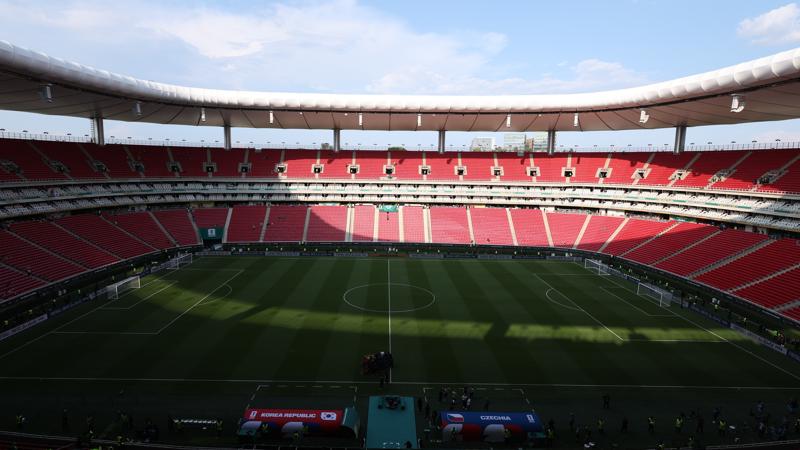
The opening matches of the 2026 FIFA World Cup in Mexico yesterday illustrated both the rapturous excitement and palpable frustration inherent to the world’s biggest sports tournament, while capturing an unintentional image that may become one of the most enduring visuals of the tournament’s return to North America and the United States in particular: Rows and rows of empty seats. Although crowds were unsurprisingly packed into Mexico City’s Azteca Stadium to witness the opening match between home nation Mexico and South Africa, it was the second match in Guadalajara between South Korea and the Czech Republic that underscored the potential issues with ticketing and affordability that have become a huge talking point with the 2026 World Cup. Although official attendance claimed the 46,000-seat stadium was almost entirely full, the live images of South Korea vs. Czech Republic seemed to tell a very different story than Mexico vs. South Africa. Empty seats and sections could be seen dotting the stadium all over, providing a potent illustration of fan complaints that ticket prices for this entire World Cup, regardless of venue and host nation, have been more punishingly inflated than any tournament in the past.
South Korea beats Czech Republic but why all the empty seats at World Cup’s second game?
South Korea beats Czech Republic but why all the empty seats at World Cup’s second game?The Athletic has live coverage of Canada vs. Bosnia and Herzegovina in the 2026 FIFA World Cup. There were large sections of empty seats at the Akron Stadium in Guadalajara …
— BYTESEU (@byteseu.bsky.social) 8:26 AM · Jun 12, 2026
Suffice to say, things have changed a bit since the last time World Cup games were hosted in the United States in 1994. All told, 11 cities in the U.S., along with five in Mexico and Canada, will host matches of soccer’s premiere tournament, but for the U.S. games in particular, fans will pay through the nose for practically any game, even the “undesirable” ones. NBC News calculated that the average price for a single hotel room and ticket to an average match would exceed $2,000 in the New York and New Jersey area in particular, equivalent to the average price of a full month of rent in Chicago. Individual marquee games, such as the aforementioned opener between Mexico and South Africa, skyrocketed all the way to $3,000 and beyond for a single ticket thanks to the ever-greedy FIFA employing dynamic pricing (which they call “variable pricing”) on the tournament for the first time, algorithmically resetting ticket prices to “whatever we think we can make you pay.”
This has set the stage for plenty of potential embarrassment, should any of the marquee events in the United States in particular be seen to have large sections of unsold seats. Even today’s opening game of the tournament for Team USA against Paraguay, hosted outside of Los Angeles at SoFi Stadium, which just avoided a labor strike with last-minute negotiations, reportedly has large numbers of tickets still available. As of a few days ago, there were still 4,400 tickets for the match floating around FIFA’s official sales and resale portals. Why so many? Well, the costs are insane: The cheapest available tickets are $1,120, while the most expensive regular seats are $2,735, a figure that is more expensive than seats for the 2022 World Cup Final. By way of comparison, the $1,120 you’d spend for the cheapest available seat here could alternatively buy you season tickets for major European soccer powerhouse franchises like Manchester United or Real Madrid. Does that sound like an expenditure the U.S. soccer fan probably wants to make in the same week that inflation is announced to have reached multi-year highs?
The funny thing is that FIFA’s justification for introducing dynamic pricing to World Cup ticketing was that ticket prices would respond to market demand.
If ticket prices only move in one direction, regardless of demand, then that’s not really dynamic pricing, is it?
— Treblig 🇺🇦 (@camtreblig.bsky.social) 9:42 AM · Jun 12, 2026
These big price jumps, and generally predatory pricing, exist across the entirety of the 2026 World Cup, and are not confined to only the biggest and most popular teams, or most important matchups. As noted in a comparison by The Athletic, the ticket price for any individual match of the World Cup, at any stage, is higher than the equivalent ticket price of any previous tournament. There’s effectively no way to attend this tournament on a budget, in other words, and the result could be more and more highly publicized empty seats. The difficulty in moving tickets has already caused the median price of resale tickets to drop, and could ultimately put scalpers into desperation mode.
Not that you would know this to listen to FIFA, which claims to have sold more than 6 million total tickets for the tournament, and said that demand for tickets had exceeded expectations by “a factor of 10 or more.” Which, if it was true … probably wouldn’t result in so many unsold tickets and obviously empty seats? FIFA President Gianni Infantino has publicly claimed that “our entry price, which is $60, is the lowest entry price of any of the American sports in the playoff phases,” while failing to mention that the actual number of “$60 tickets” is so small that it can’t be said to practically exist at all, and presumably only technically exists so he can mention it. Keep in mind that Infantino also pays President Donald Trump’s company directly by renting unused, empty space in Trump Tower in NYC, and presented the POTUS with a newly created “FIFA Peace Prize” in an effort to buy his favor. There’s a reason why millions of European soccer fans have filed consumer complaints against this organization.
Of course, U.S. regulators have already had some complaints of their own as well. Last month, New Jersey’s AG Jennifer Davenport and New York AG Letitia James both announced their offices were launching investigations into FIFA’s dynamic pricing practices for the 2026 World Cup, noting that between October of 2025 and April 2026, FIFA raised game ticket prices for almost every match in the tournament by an average of 34%. Even Ken freakin’ Paxton, Attorney General of Texas and a man consumed by endless corruption investigations of his own, just launched a similar investigation in his own state, brought on by consumer complaints of FIFA World Cup tickets that were changed in location after they had already been purchased. When even someone on the forefront of U.S. political graft finds space to criticize your organization’s business practices, then you know you must be bilking the consumer at levels heretofore thought impossible.
The proof, ultimately, may be in the empty seats. Each empty row that appears on camera throughout this tournament will be a blow to FIFA’s pride and attitude of untouchability.
I warned the Trump admin of this exact eventuality.
Their actions combined with FIFA’s ridiculous pricing schemes have discouraged fans from coming to games & now, one day before kickoff, ~180K tickets remain unsold.
Our local businesses are being shortchanged.
www.ft.com/content/ac26…
— Senator Chris Van Hollen (@vanhollen.senate.gov) 5:26 PM · Jun 10, 2026
 Keep scrolling for more great stories.