

Woman Gets $100,000 from Nevada After They Put Her Behind Bars for a Miscarriage
“I can cushion everything, but it’s not going to fix my problems,” she told the Nevada Independent. “[I] lost a lot of hope that I’m still struggling to get back.”
Photo: Getty Images Abortion
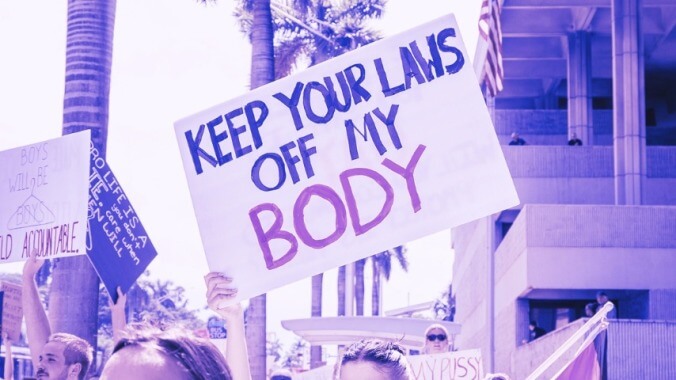
Years after a woman was arrested, charged, and imprisoned for manslaughter after she had a stillbirth in rural Nevada, the Silver State on Tuesday was finally ordered to pay her $100,000 to compensate her for the entire ordeal. Which is nothing compared to the trauma the state inflicted on her.
Patience Rousseau miscarried in April 2018, when she was 26 (and then went by the last name Frazier), then wrapped the remains and buried them in her backyard, marking the spot with a cross. Her babysitter, who’s been described as “devoutly Christian,” reported her to the police, and Sheriff Deputy Jacqueline Mitcham—who got the tip—engaged in a dogged hunt to incriminate her. (Rousseau and Mitcham shared the same babysitter.) Rousseau was eventually charged with felony manslaughter under a 1911 law, which makes it illegal to use drugs to terminate a pregnancy after 24 weeks. According to her lawyer, she is the only person who’s been charged and convicted under the law.
“I can cushion everything, but it’s not going to fix my problems,” Rousseau told the Nevada Independent in response to the settlement, which was approved by a Board of Examiners, a panel that included the governor, the attorney general, and the secretary of state. “What does it really mean for me? How long is it going to last?”
Her story was initially reported by the Indy in 2022, but received national attention after the Washington Post obtained bodycam footage from her arrest, and spoke to multiple people involved in the investigation. One of the detectives admitted to the Post that he believed Rousseau killed her baby and recalled thinking, “We have to find a charge that works…She has to be charged with something.”
The Post also reported that, while the woman was incarcerated, Mitcham convinced a funeral director to give her the fetal remains, telling the outlet, “I’m taking him…that’s my baby,” and adding that she’s the only person who ever loved him. As of October, Mitcham was still keeping the remains in a box in front of her house.
After her public defender convinced Rousseau to plead guilty to the manslaughter charges, she went to prison in 2019. Her conviction was ultimately vacated in 2021, and the case itself was dismissed in 2025. “[I] lost a lot of hope that I’m still struggling to get back,” she told the Indy.
The 1911 law makes Nevada “the only state where it is a felony to have an abortion,” Farah Diaz-Tello, a Senior Counsel and Legal Director at If/When/How told the outlet. “Even in the states with the most draconian abortion bans, there is language explicitly saying that a person who has an abortion has not committed a crime,” she continued. “Not Nevada.” Apart from the obscure 1911 law, in which the section is literally titled “taking drugs to terminate pregnancy,” abortion is technically legal in the state up to 24 weeks.
Prosecutors could never actually prove that the woman took abortion pills—but because she scheduled an abortion in Reno in 2018, and was struggling with substance use disorder while pregnant, they argued she took methamphetamines and marijuana to induce a miscarriage, thus violating the law.
And substance-related criminalization is the clearest manifestation of the fetal personhood movement, in which anti-abortionists are working to establish equal protections for fetuses and the pregnant person. “When we redefine ‘child’ to include ‘embryo’ and ‘fetus,’ pregnant people get charged with crimes,” Dana Sussman at Pregnancy Justice, who tracks pregnancy criminalizations, told Jezebel after releasing its latest annual update in October.
Speaking to the Indy, Rousseau said her conviction came at a period in her life when she most needed help, adding that many young abortion-seekers “don’t feel like they can care for another child…whether it’s their living situation, their financial situation, they’re struggling or barely making it by with what they have.”
 Keep scrolling for more great stories.